

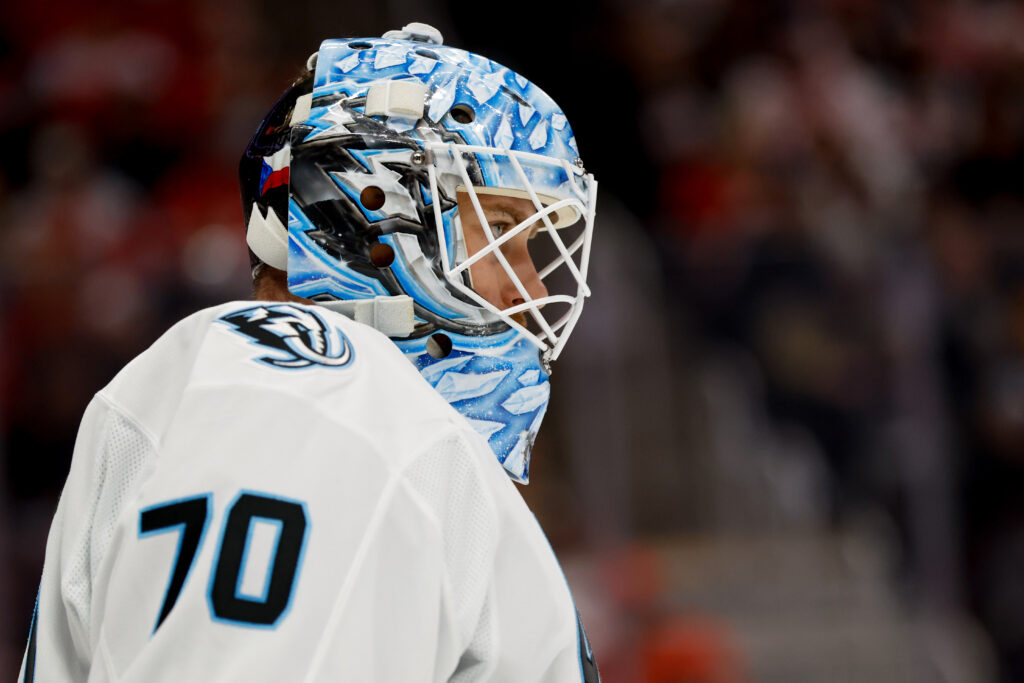
The Utah Mammoth were a pre-season favorite to make the Western Conference playoffs after making a number of high-profile moves this past offseason. The Mammoth made several big moves dating back to last season, acquiring MacKenzie Weegar, Anders Lee, Vincent Trocheck, and young goaltender Sebastian Cossa, whom they brought in from the Detroit Red Wings in a summer trade.
The acquisition of Cossa left the Mammoth with a tandem of Cossa and Karel Vejmelka, which the team felt comfortable with, and for good reason. However, a quarter of the way through the season, the Mammoth have to be concerned about the goaltending they’ve received.
Overall, the team has played well, controlling roughly 57% of the expected goals at five-on-five, which ranks second in the NHL. They’re also allowing 2.15 expected goals against per 60 minutes, which is solid.
Despite these underlying numbers, the team has been outscored at five-on-five so far this season, largely due to inconsistent goaltending.
Vejmelka has been a shell of himself this year compared with his work from just a season ago. Vejmelka was a workhorse last season, dressing in 64 games and posting an .897 SV%, 2.75 GAA, and 6.9 goals saved above expected (per MoneyPuck).
Those numbers stand in stark contrast to this year’s .872 SV%, 3.14 GAA, and -7.0 goals saved above expected.
The netminding situation is even more dire when Cossa takes to the crease, as the 23-year-old has an .863 SV% and a 3.56 GAA in eight games this year. Cossa had just one game of NHL experience before this year, so it’s not fair to put all the blame on the Hamilton, Ontario, native.
Cossa’s inexperience won’t offer much comfort to Mammoth fans or management, especially after the team traded a 2026 first-round pick for him in June. Cossa’s inexperience likely buys him some patience, but the team can ill afford to wait for good goaltending if they hope to make the playoffs in the crowded Western Conference.
Now, in fairness to Vejmelka and Cossa, the team’s defense could be better, and some players have even acknowledged this in interviews. However, they allow the fifth-fewest shots per game in the NHL, so they are likely doing a reasonable job of preventing scoring opportunities.
Utah’s goaltending isn’t the only issue plaguing the team, as they have dealt with a rash of injuries to key players such as Logan Cooley, Nick Schmaltz, and Dylan Guenther. Their penalty kill has also been a problem, killing off power plays at a 69.33% clip, well below the league average of 77.69%.
Much of the poor penalty killing could be attributed to goaltending, but it’s certainly another area of concern.
Despite the issues, it would be surprising to see Utah make a substantial goaltending move this early in the year. Vejmelka is a capable NHLer and has been for a long time, so it seems the Mammoth would let him figure it out.
They might look to add a third goalie to challenge the struggling duo of Cossa and Vejmelka, but even that feels like a move for the new year.
It’s clearly a problem right now, but goaltenders can be unpredictable, especially young ones. The Mammoth aren’t likely to let this linger too far into 2027, though, since they’ve invested heavily in making this group a playoff team.
Whether that means a trade or rolling with just one netminder remains to be seen, but the Mammoth need at least league-average goaltending, and they simply aren’t getting it.
If the Mammoth look to the trade market, they have no shortage of assets to make a splash. The Mammoth have a top-five prospects system in the NHL and also have their full catalogue of draft picks for the next four NHL Entry Drafts, plus a few extras sprinkled in, including a 2028 conditional first-round pick from the Florida Panthers that came via the Boston Bruins in the JJ Peterka deal.
A few goaltenders who are out there include Sam Montembeault of the Montreal Canadiens, John Gibson of the Detroit Red Wings, and, of course, Jordan Binnington of the St. Louis Blues. Would any of those names be an upgrade for Utah?
Probably not, but it would add depth if Vejmelka and Cossa keep struggling.
In fact, all three goaltenders mentioned have their own concerns and would be flawed acquisitions, worth pursuing only if Utah gets desperate. Montembeault has yet to play a game this year and has been dealing with an injury.
Even when healthy, he is likely Montreal’s number three netminder. Gibson has been downright awful this year in Detroit, with a goals-saved above expected of -7.6 in just 13 games.
That figure is the third-worst mark in the NHL, behind Binnington at -8.2 goals in six games and Kevin Lankinen in Vancouver.
A better option than those three for Utah, though this is somewhat laughable, would-be Matt Murray, a free agent who played decently in a handful of games with the Seattle Kraken last year. Again, he has injury concerns, but unless Utah wants to go big-game hunting, the goalie market is currently sparse.
Utah’s best option might be to wait and see, as they have been doing, and it will be interesting to see whether Cossa and Vejmelka figure it out or whether Utah has to pivot to find a solution.